Artificial Intelligence, Human Resources
Stephen Karaolis
|
Human Resources (HR) has traditionally been the backbone of every organization, ensuring smooth operations from recruitment and onboarding to employee well-being. But the role of HR is evolving rapidly, largely driven by technology. Today, HR teams are constantly overwhelmed, spending the majority of their time in a reactive mode—responding to tickets, answering repetitive questions, and handling the minutiae of daily employee requests.
In a future driven by artificial intelligence (AI) and automation, this reactive model will transform. AI promises to free HR professionals from the day-to-day grind of repetitive tasks and enable them to focus on more strategic, people-centric initiatives. This shift, from reactive to proactive HR, is the cornerstone of what we call the HR Support Model of Tomorrow. In this blog, we’ll explore how AI will fundamentally change HR, the evolving support model, and the future trends driving this transformation.
The Current State of HR: Reactive and Overwhelmed
HR teams face an overwhelming amount of work. Much of this work is spent addressing repetitive tasks that take up 80-90% of their time.
These tasks often include answering the same basic questions—like “How do I reset my benefits password?” or “What’s our company’s maternity leave policy?”—over and over again. The result? HR teams are constantly in “reactive mode.”
Being in reactive mode means HR professionals are too busy with immediate tasks to focus on higher-value activities. Organizations often sideline strategic initiatives, such as improving employee engagement, developing leadership programs, or enhancing the overall workplace culture. This leaves HR stuck in the weeds, handling repetitive requests instead of contributing to larger organizational goals.
The truth is, if HR teams keep working reactively, they won’t have time to focus on the future. To break free from this cycle, HR should embrace technology, especially AI. They need to rethink how they work.
The Three-Tier HR Support Model Today
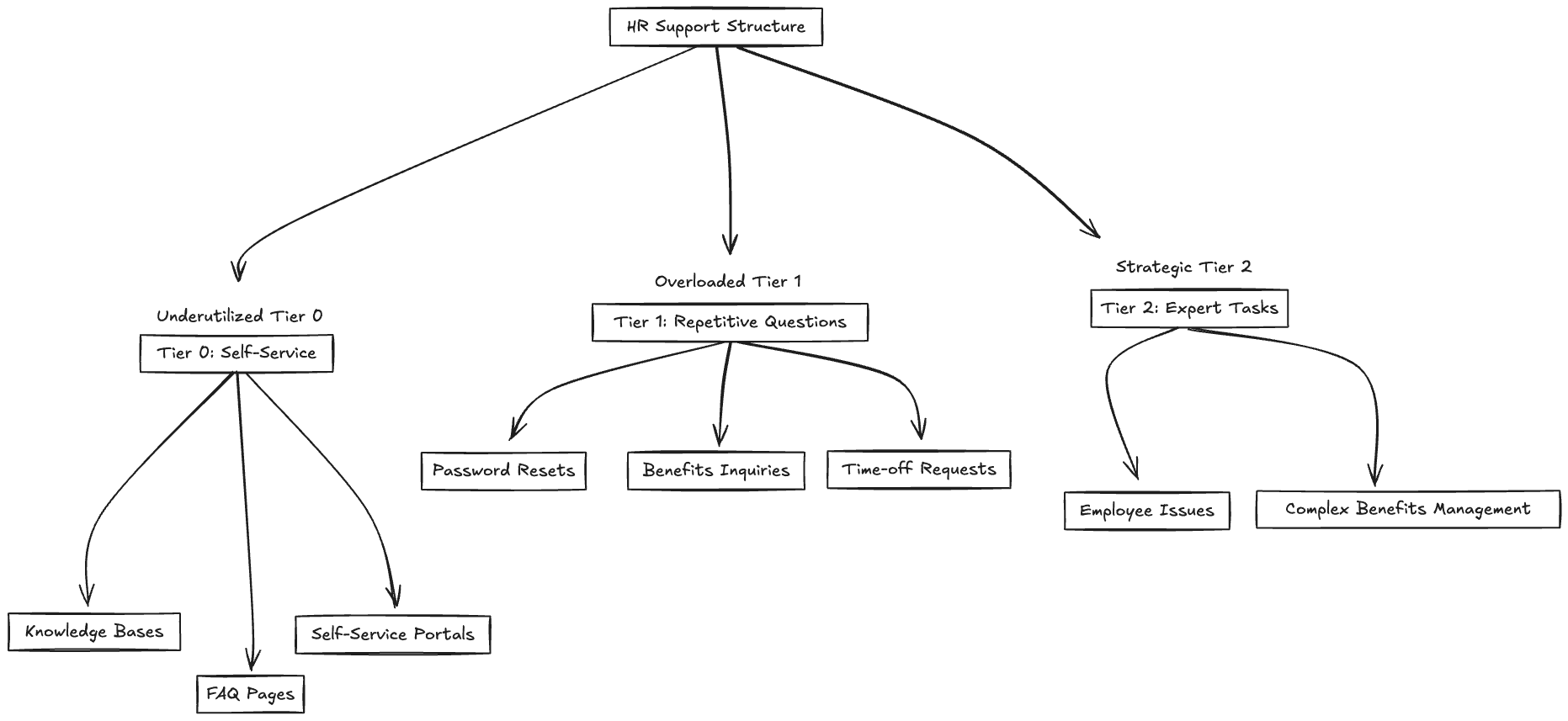
To understand how the future will look, it helps to break down the existing HR support structure. Many HR teams operate using a three-tier support model:
Tier 0: This is the self-service layer. Here, employees and managers can find answers to their questions without needing HR. It includes knowledge bases, FAQ pages, and self-service portals.
Tier 1: This is where HR teams handle simple, repetitive questions. These include password resets, benefits inquiries, and time-off requests. Users primarily engage in a Q&A-based interaction that they could automate or self-service in theory.
Tier 2: This includes more complex tasks that need expert knowledge in HR. Examples are managing a sensitive employee issue or making sure employees in a new division get the right benefits.
Today, most HR teams spend their time on Tier 1 tasks. These tasks could be automated or handled by a self-service platform. Users underutilize Tier 0, on the other hand.
Many organizations lack strong knowledge bases or self-service tools. This leads to many Tier 1 requests that slow down HR’s productivity.
The HR Support Model of Tomorrow
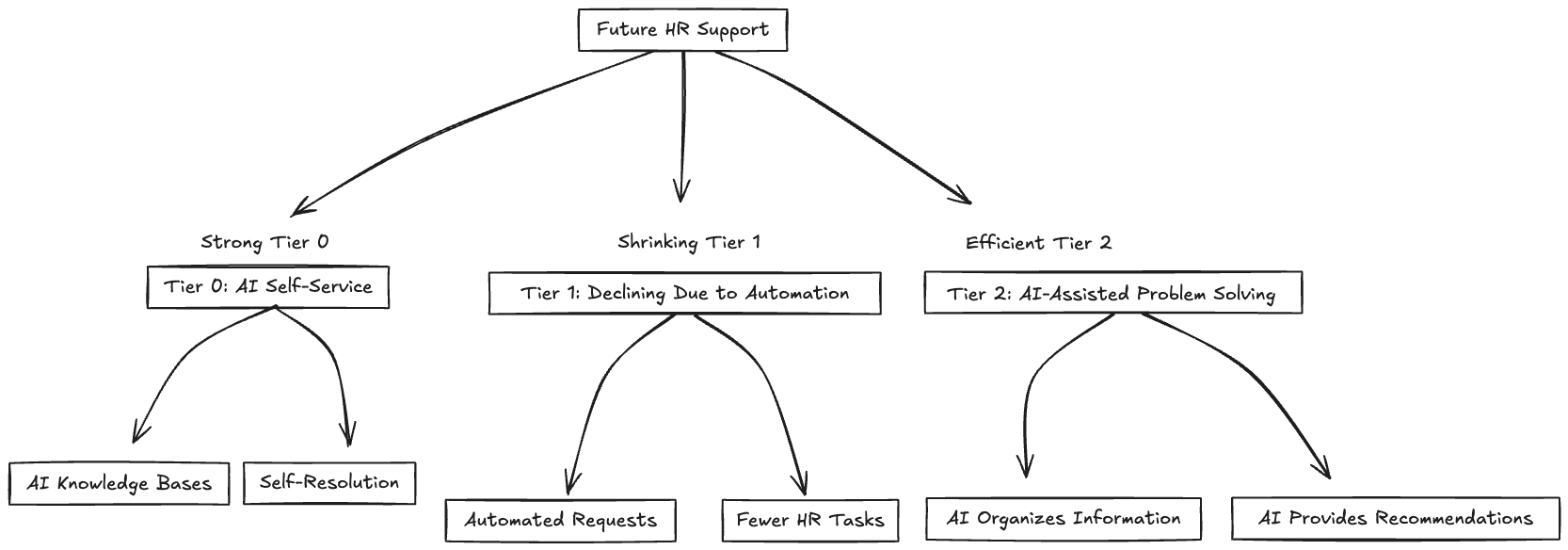
So, what does the future hold for HR? The future of HR will look very different. Thanks to advances in AI and automation, the landscape will shift dramatically, especially in how the different support tiers are managed.
Tier 0 Expansion: In the future, Tier 0 will be much more robust. Employees and managers will have access to AI-powered knowledge bases that can answer the most common questions instantly. This expansion will allow employees to resolve issues themselves, without needing to contact HR. AI will keep updating and improving its knowledge base. It learns from past interactions to give better answers over time.
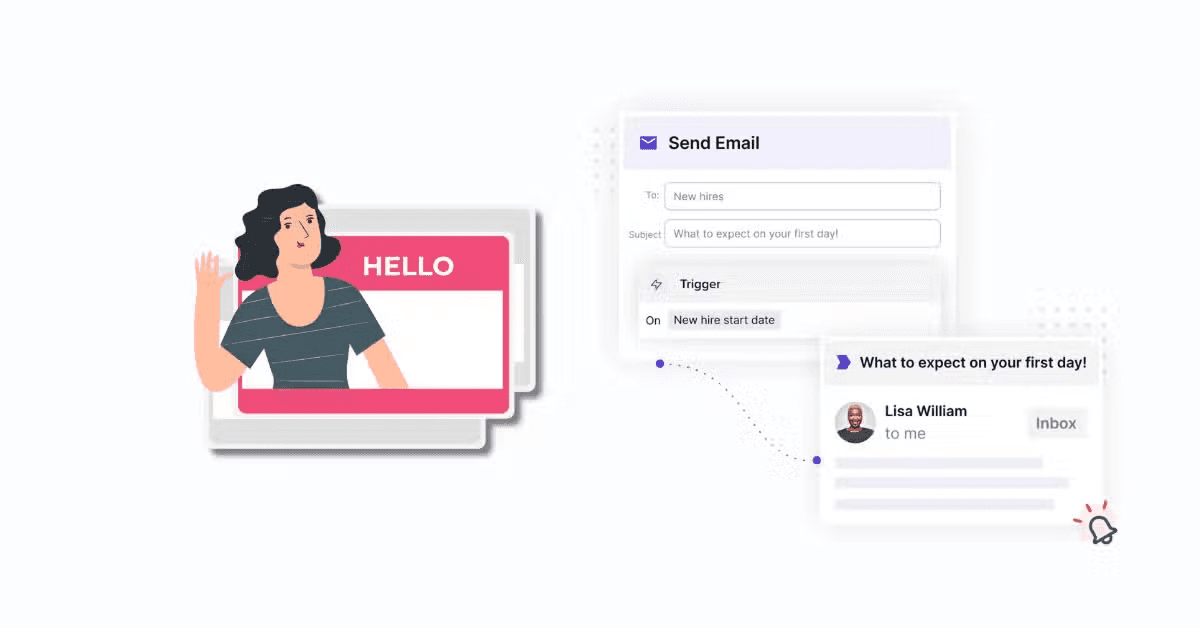
Decline of Tier 1: The need for Tier 1 support will shrink significantly as more tasks are automated. HR professionals used to handle questions about basic processes and form submissions. Now, smart systems will take care of those tasks. For example, AI could automate a PTO request form or automatically send relevant policy information to an employee inquiring about commuter benefits. This will allow HR to focus on more complex and strategic matters.
Tier 2 Transformation: While Tier 2 will remain, it too will become more efficient. AI tools will help gather the necessary information, organize tasks, and even provide recommendations for HR professionals before they engage in the actual problem-solving. This ensures that when HR professionals do need to step in, they’re equipped with everything they need to handle the situation efficiently, without wasting time on administrative tasks.
In short, the future of HR will involve a far more powerful Tier 0, a reduced need for Tier 1, and a more streamlined, efficient Tier 2.
The Role of AI in HR Transformation
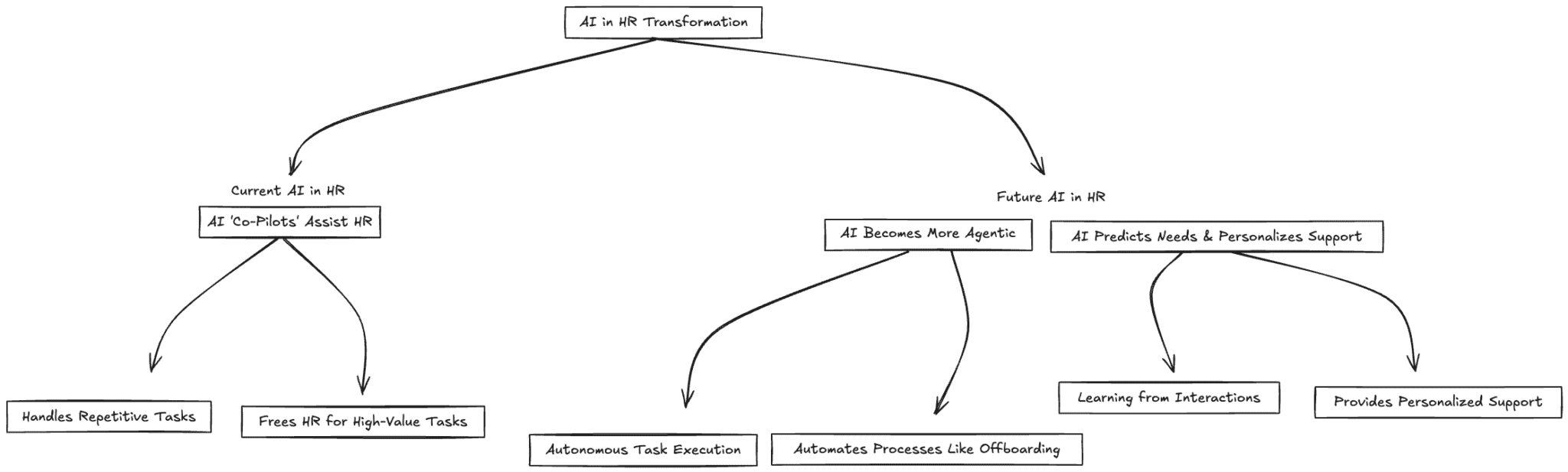
AI is at the heart of this transformation. We’re already seeing the rise of AI “co-pilots” in HR—a term used to describe AI systems that assist HR professionals by handling repetitive, low-level tasks. These co-pilots allow HR teams to be more efficient, handling the grunt work so that HR professionals can focus on high-value tasks.
But AI in HR goes beyond simple automation. Over time, these AI systems will become more agentic, meaning they’ll be capable of making decisions and executing tasks autonomously. This will further reduce the need for human intervention in repetitive processes. For instance, AI could fully automate the offboarding process—scheduling exit interviews, sending required documents, and ensuring that all internal systems are updated—while HR professionals focus on more complex employee relations tasks.
As these AI systems learn from interactions, they’ll become better at predicting what employees and managers need, offering more personalized and efficient support. Eventually, AI won’t just be a helpful tool—it will be a core part of how HR operates.
Trends Driving HR Evolution
Several trends are driving this shift in HR, beyond just advances in AI technology:
Remote and Hybrid Work: The rise of remote and hybrid work environments has created new challenges for HR teams. Managing a distributed workforce across different cities, states, and even countries requires more complex compliance and communication strategies. With employees scattered across various locations, the need for efficient, automated HR processes has never been greater.
Compliance and Risk Management: With employees working in multiple regions, HR teams must navigate a patchwork of compliance requirements, from local labor laws to international tax policies. AI can help manage these complexities by automating compliance tasks and keeping HR up to date on regulatory changes.
Economic Pressures: In a world where budgets are tighter and companies are expected to do more with less, HR teams need to become more efficient. AI offers a way to reduce the manual workload, allowing HR to operate leaner without sacrificing effectiveness.
Together, these trends highlight the increasing demand for efficiency in HR—something that AI is uniquely positioned to address.
What This Means for HR Teams
For HR teams, this shift from reactive to proactive isn’t just about adopting new technologies—it’s about rethinking the way they work.
From Reactive to Proactive: By offloading repetitive tasks to AI, HR teams will finally have the bandwidth to focus on what really matters: people. Instead of spending their days answering the same questions over and over again, HR professionals can devote more time to strategic initiatives—like employee engagement, leadership development, and building a strong company culture.
Enabling Managers: Managers, too, will benefit from AI-powered HR tools. With better self-service options, employees can manage routine HR tasks themselves. This will allow HR professionals to focus on bigger issues.
The Human Element: While AI will undoubtedly streamline HR processes, it will also enhance the human element of HR. AI makes daily operations more efficient. This allows HR professionals to focus on the parts of their job that need a human touch. They can coach a manager through a tough conversation or help an employee with a complex benefits issue.
Conclusion
The future of HR is bright—and it’s powered by AI. By moving away from reactive, manual processes and embracing AI-driven automation, HR teams can finally focus on what they do best: enabling people.
The future of HR is where AI handles repetitive tasks, freeing up HR professionals to engage with employees, improve workplace culture, and drive organizational growth.
As these changes take hold, HR will no longer be the reactive department that only answers questions and processes paperwork. Instead, HR will become a proactive, strategic force that helps shape the future of the organization—one where people, not paperwork, are the priority.